This page is restricted to US residents.
Short answer: Satellite Beach assesses property owners throughout the city an annual stormwater utility fee, a non-ad valorem assessment under City Code chapter 52 that is collected with property taxes and is measured in equivalent residential units tied to the Brevard County method. Storm drains carry untreated runoff to the Banana River Lagoon, and the city's projects list credits ponds, bioswales and filters to state and other grants, and dumping is reported to Code Enforcement at (321) 773-4409.
Last verified: October 22, 2026, against the sources listed at the end of this page.
Where does rain that falls on a Satellite Beach street end up?
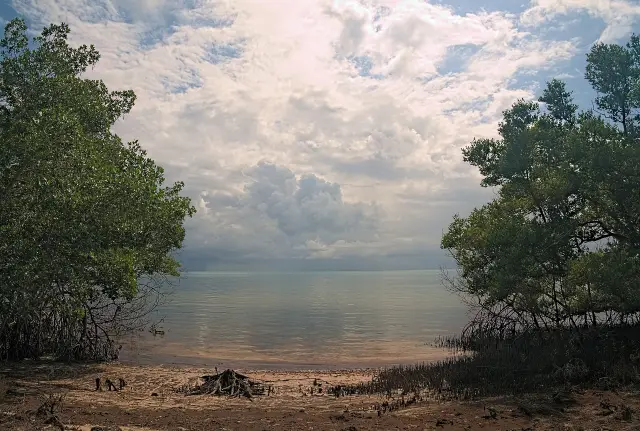
Rain that runs off Satellite Beach streets, roofs and driveways enters the city storm sewer system and flows to the Banana River Lagoon, a sub-section of the Indian River Lagoon, without treatment.
The Public Works stormwater page separates two pipe networks: storm drains are the openings and grates along curbs, in streets and in parking lots, and what enters them does not go to a treatment facility, while the sanitary sewer carries waste from toilets, sinks and showers to a wastewater treatment facility (Satellite Beach Stormwater page). The same page states that putting oil, antifreeze, paint, detergents, and lawn and garden clippings into the storm drainage system is illegal and does the same harm as dumping them straight into the Lagoon.
The city code frames the same problem in its findings. Chapter 52 opens with the Satellite Beach council's finding that uncontrolled drainage and development of land harms the city and areas next to it, including the Indian River Lagoon Estuary, and lists effects such as pollutants carried into receiving waters, nutrient-driven eutrophication, erosion and lost groundwater recharge where impervious surfaces grow (City Code chapter 52). The chapter's stated objectives include a program compatible with those of the Florida Department of Environmental Protection, the St. Johns River Water Management District and Brevard County.
How does the Satellite Beach stormwater utility fee work?
All real property inside Satellite Beach city limits sits in one stormwater benefit area, and property owners there are assessed an annual stormwater utility fee, which the code makes a non-ad valorem assessment.
Chapter 52 was added by Ordinance 681, adopted July 2, 1997, and it creates the benefit area to encompass all real property within the municipal boundaries of the city (City Code chapter 52). Section 52-5 creates the fee under state law and says the fee shall constitute a non-ad valorem assessment. The unit of measure is the equivalent residential unit, or ERU, which the definitions section ties to the rate established by the Brevard County Board of County Commissioners under its most current methodology for stormwater assessment rolls and under the interlocal agreement between the city and the county.
State law is the authority behind that structure. Section 403.0893 of the Florida Statutes lets a county or municipality create stormwater utilities, adopt fees sufficient to plan, construct, operate and maintain stormwater management systems, and create stormwater management system benefit areas, with subareas assessed different per acreage fees where land uses receive substantially different levels of stormwater benefits (Section 403.0893, Florida Statutes). The statute adds that such fees may use the non-ad valorem levy, collection and enforcement method in chapter 197, the route the Satellite Beach code follows.
When does the Satellite Beach council set the stormwater rate?
The Satellite Beach council must hold a public hearing on a stormwater rate resolution on or before September 15 each year, after newspaper notice.
Under Section 52-5 the rate resolution carries a schedule of rates and classifications for all affected real property in the benefit area, and on or before the end of each fiscal year the council adopts a stormwater operation and maintenance budget for the ensuing fiscal year, including debt payments and reserves; the rates must raise enough revenue to fund that budget (City Code chapter 52). Notice of the hearing goes in a newspaper of general circulation in Brevard County at least twice, the first time at least 20 days before the hearing.
A second September deadline follows in Section 52-6: by the same date the city prepares an annual stormwater assessment roll from Brevard County property appraiser information, listing each parcel, its owner's name and address, its rate classification and its assessment, and the council reviews the roll prepared by the city manager, conforms it to the rate resolution and certifies it to the tax collector (City Code chapter 52). The state's uniform collection statute uses the same calendar, requiring the chair of a local governing board or a designee to certify a non-ad valorem assessment roll to the tax collector by September 15 (Section 197.3632, Florida Statutes).
How is the stormwater assessment billed, and what if a Satellite Beach parcel is charged in error?
The Satellite Beach stormwater assessment arrives on the yearly property tax notice and is collected and enforced the same way as ad valorem taxes.
For Satellite Beach parcels, Section 52-7 applies the early payment discount, installment prepayment, delinquency penalty and tax certificate and tax deed provisions of Section 197.3521, and warns that nonpayment results in a tax certificate against the property and may result in the loss of title (City Code chapter 52). Assessments collected under the uniform method go on the combined notice for ad valorem taxes and non-ad valorem assessments, and state law allows a separate mailing only in the most exigent circumstances (Section 197.3632).
| Situation | Rule in chapter 52 | Section |
|---|---|---|
| Owner believes the Satellite Beach assessment is wrong, or claims an exemption | Written petition to the city within 30 days of the mailing of the final notice of taxes and assessments; late petitions are barred | 52-9 |
| Parcel left off the roll by mistake | City may impose the current year plus up to the prior two fiscal years by resolution; delinquent 60 days after adoption | 52-10 |
| Property owned by a government agency | Initial assessment does not apply; city agencies never pay | 52-11 |
| Private lessee of government land | Chapter applies to the leasehold | 52-12 |
| Property exempt from taxation | Tax exemption does not relieve the owner of the stormwater assessment | 52-13 |
A Satellite Beach petition under Section 52-9 must give the owner's name, a legal description of the property, a summary of the claimed error or exemption and the relief sought, and the council may hear it or delegate it to a stormwater utility appeals committee set up by resolution (City Code chapter 52).
What can Satellite Beach spend stormwater utility money on?
Satellite Beach must deposit stormwater fees in a stormwater utility fund held in trust and spend it only on the stormwater management program.
Section 52-14 of the Satellite Beach code limits the fund to these uses: operating or maintaining stormwater facilities within the city, planning, evaluation, design, construction and management of the program, program administration, management services such as permit review and development review tied to the program, and debt service on stormwater capital improvements (City Code chapter 52). The 1997 purpose section of the chapter makes the city program responsible for the construction, operation and maintenance of stormwater devices, stormwater system planning, review of development plans and estuarine and ocean quality management.
Grants are named beside several listed projects. On the City Projects page, Satellite Beach credits recent drainage jobs to FDEP and ARPA money, SJRWMD grants and grants abbreviated SOIRL, and its overview says the city adds water quality improvements where feasible while upgrading the stormwater management system so that pollutants are attenuated before reaching the Indian River Lagoon (Satellite Beach City Projects page).
Which drainage and treatment projects has Satellite Beach built?
The Satellite Beach City Projects page lists completed stormwater treatment work dated from 2019 through 2025, ranging from a 1.5 acre pond at the Catino Sports Complex to floating wetlands in the City Hall pond.
| Project (year listed) | What was built | Funding named |
|---|---|---|
| Catino Sports Complex Stormwater Management Facility (2019) | 1.5 acres of stormwater treatment pond and recreation complex | Not stated |
| Temple/Ellwood Treatment Facility (2021) | Small dry retention area at Temple and Ellwood | Not stated |
| Schechter Center Bioswales (2021) | BAM-lined bioswales in the Schechter Center parking lot | Not stated |
| Jackson Court Pond (2022) | Half-acre facility of linked dry and wet ponds at Jackson Ct. and South Patrick | Not stated |
| City Hall Living Shoreline (2025) | Beemats (floating wetlands) in the City Hall pond to take up nutrients | FDEP/ARPA grant |
| South Ditch Basin Stormwater Improvements (2025) | BAM filter retrofit of the Jamaica pond, BAM swales, treatment in the Sports Park, and diversions of Robert and Robin Way into retention | FDEP/ARPA grant |
The South Ditch Basin entry says that project treats 58.27 acres in the southern portion of the city (Satellite Beach City Projects page). Two further completed entries, the Roosevelt Avenue baffle box and the Lori Laine trunkline, are covered in the Satellite Beach sea level rise guide. Still ahead on the same page are the Jackson Avenue streetscape between South Patrick Drive and A1A, listed as a current project with sidewalks, bioswales and landscaping funded by FDOT and FDEP grants and city funds, and the Westside Basin project, listed as planned, adding treatment swales and tree wells to the basin west of South Patrick Drive with FDEP and SOIRL grants.
What counts as an illicit discharge in Satellite Beach, and whom does a resident call?
Satellite Beach treats any non-stormwater dumping into its drainage system as an illicit discharge and asks residents to report it to Code Enforcement at (321) 773-4409.
The stormwater page gives that number with the address [email protected] for reporting a possible illicit discharge or illicit connection, and names paint, construction materials and oils as examples (Satellite Beach Stormwater page). The city's Beachcaster newsletter for November and December 2025 printed a longer list that includes cleaning and equipment washing waste, vehicle fluids, commercial vehicle washing, cooking oil and grease, laundry wastewater and chlorinated pool water (Beachcaster, November to December 2025).
Pool owners get specific steps on the stormwater page: stop adding chemicals and let the water stand for 10 days before draining, confirm a pH between 6 and 8 and no detectable chlorine or bromine, drain to grass rather than a storm drain where possible, and never send backwash water to a storm drain (Satellite Beach Stormwater page). For household hazardous waste the page points to the Sarno Landfill, which it says accepts a variety of wastes free of charge to residents, at (321) 255-4452. The Satellite Beach Public Works Department, which runs the stormwater program, is at 240 Jackson Avenue, (321) 777-2309, [email protected]. Last verified: October 21, 2026, by rereading chapter 52 of the Satellite Beach code, the Public Works stormwater and City Projects pages, the November to December 2025 Beachcaster and Sections 403.0893 and 197.3632 of the Florida Statutes.
Frequently asked questions
Do Satellite Beach storm drains go to a treatment plant?
No. The city stormwater page says water entering storm drains does not go to a treatment facility and flows to the Banana River Lagoon, part of the Indian River Lagoon.
Is the Satellite Beach stormwater fee a tax?
City Code chapter 52 makes the stormwater utility fee a non-ad valorem assessment, collected on the property tax notice and enforced like ad valorem taxes.
How is the Satellite Beach stormwater fee calculated?
Chapter 52 uses the equivalent residential unit, or ERU, set by the Brevard County Board of County Commissioners methodology, and the council adopts a rate resolution each year on or before September 15.
How can a Satellite Beach owner dispute a stormwater assessment?
Section 52-9 allows a written petition to the city within 30 days of the mailing of the final notice of ad valorem taxes and non-ad valorem assessments; late petitions are barred.
Can pool water be drained into a Satellite Beach storm drain?
The city asks owners to let pool water stand for 10 days without chemicals, check pH and chlorine, drain to grass where possible and never discharge backwash to a storm drain.
Sources
- Stormwater, City of Satellite Beach Public Works https://www.satellitebeach.gov/departments/public-works/stormwater/ Used for: storm vs sanitary sewer, illicit discharge contact, pool draining, Sarno Landfill, Public Works contact
- City of Satellite Beach Code of Ordinances, Chapter 52 Stormwater Utility (Municode) https://api.municode.com/CodesContent?jobId=500763&productId=12849&nodeId=PTIICICO_CH52STUT Used for: benefit area, fee, ERU, rate hearing, roll, collection, petitions, exemptions, trust fund
- City Projects, City of Satellite Beach Public Works https://www.satellitebeach.gov/departments/public-works/city-projects/ Used for: stormwater project list, funding
- Beachcaster newsletter, November to December 2025, City of Satellite Beach https://www.satellitebeach.gov/media/vh2gmb4n/beachcaster-nov-dec-2025.pdf Used for: illicit discharge examples
- Section 403.0893, Florida Statutes: Stormwater funding https://www.flsenate.gov/Laws/Statutes/2025/403.0893 Used for: authority for stormwater utilities and benefit areas
- Section 197.3632, Florida Statutes: Uniform method for non-ad valorem assessments https://www.flsenate.gov/Laws/Statutes/2025/197.3632 Used for: September 15 certification, combined notice
Published by Rytas Dirse, Solo Founder & AI Architect
Built with AI, held to quality gates. US sources, US brands, facts only.
How this page was made
Digital Towns uses AI assistance to research and write its guides, and every page is only as good as the sources it cites. Our goal is the most accurate, useful local information possible.
If you see an error, or anything you can show is false, tell us right away and we will take a third look.
Report an error
Thank you. We'll take a third look and correct the page if it's wrong.